
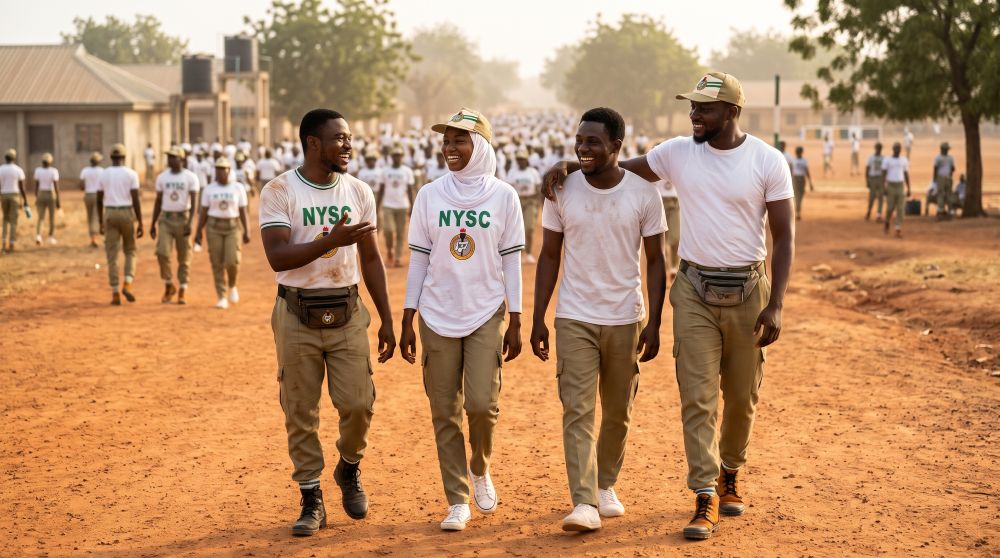
“Platoon 3! Fall in!”
It was 5:00 a.m., and Tunde was already questioning every decision that brought him to the NYSC orientation camp.
The Lagos boy had been posted to Bauchi.
He had never travelled that far north. His mother had called him 15 times before he arrived. His friends had filled his head with warnings.
Now, standing under the morning sky in oversized khaki, he was surrounded by strangers.
Beside him stood Chika, with broad shoulders, from Anambra.
Behind him was a slim, tall lady - Fatima - from Kaduna.
And somewhere at the back was Efe from Delta, who had already become famous for complaining about everything.
By the third day, these strangers on Day one had become were friends.
They talk and spend their time together regardless of their differences because the orientation camp had given them something stronger to discuss.
They talk about how to survive the tedious morning drills, why the food never seemed enough, or how one person could possibly shout “Corper, double up!” so many times before breakfast.
One afternoon, Tunde fell sick. His new friends were there to assist him. Fatima helped him get medication, while Chika brought him food, and Efe volunteered to collect his meal ticket.
None of them questioned their State of Origin before assisting. Nobody asked whether helping a Yoruba boy would benefit their ethnic group.
Tunde was their friend and that was enough.
This is one of the quiet possibilities of the National Youth Service Corps.
For many young Nigerians, NYSC is their first opportunity to live closely with people whose languages, religions and customs are different from theirs.
It is not always a comfortable experience.
Some corps members face insecurity, discrimination and difficult living conditions. Others struggle with cultural misunderstandings.
But for many, the experience also creates friendships that outlive the service year.
A roommate may become a business partner. And a fellow platoon member may just become a wedding guest. A stranger from another region becomes someone you call when life gets difficult.
It becomes harder to believe that everyone from a particular community is dangerous when someone from that community has shared their last N1,000 with you.
And even harder to reduce people to stereotypes when you have laughed, argued, cooked and struggled together.
At the end of orientation camp, Tunde's mother called.
“Hope you are being careful with those people?”
He smiled.
“Mummy, which people?”
“The people over there.”
“Mummy, they're my people now,” he responded happily.
Perhaps that is the power of genuine human connection.
It does not require us to forget where we come from.
It reminds us that our circle of belonging can grow.
What if we stopped waiting for national service to teach us how to see one another as fellow Nigerians?
We can indeed have many identities, but shared citizenship.